

Preview
Creation Date
6-1-1921
Description
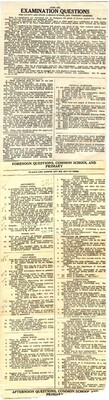
Very long and thing document with two columns of text for most of the document. Source: Examination Questions for County and State Common School and Primary Licenses Vertical File Collection. Language: English. Text: Examination questions for county and state common school and primary licenses Note 1: applicants are requested not to designate the grade of license applied for . they will receive whatever their grade and eligibility merit. Note 2- all applicants not “in the service” prior to 1908 must have certificates of their professional training on file in the State department of public instruction before the licenses can be issued by the state. Note 3- applicants for primary licenses will answer any three of the eight common school questions and the three primary questions for each subject on which they write. Note 4- the subjects of the examinations are as follows: required by all applicants- orthography, reading, writing, arithmetic, geography, grammar, physiology, and scientific temperance, or” principles of health control” united states history, science of education or “the teacher: the school and the community” or “moral education in school and home” and literature. Optional: music drawing, agriculture, domestic science, and industrial arts. (seventh and eighth grade teachers are required to secure licenses in domestic science and either agriculture or industrial arts, if they teach such subjects. Note 5- Two plans of examination designated as Plan 1 and Plan !! are offered. Under Plan 1 applicants must take all required subjects, and such optional subjects as they may select, at one examination with the privilege of being conditioned. Under Plan ii applicants are permitted to take the required subjects an such optional subjects as they may elect in two consecutive examinations without the privilege of being conditioned. The subjects of the first division are: arithmetic, grammar, literature, history, music, drawing, agriculture, domestic science, and industrial arts. The subject of the second division are: reading, physiology or thee principles of health control, geography, ad science of education, or the teacher, the school, the community or moral education in the school and home Note 6- conditioned subjects: applicants may be conditioned only under plan I and in case of failure in not more than two subjects. Applicants who fail in more than two subjects are considered failures in the entire examination. Under Plan II no conditions are allowed and applicants must make the required grades and average in all subjects taken. Under both plans all subjects upon which applicants write, including optional subjects, are counted in determining the success or failure of the manuscript. Note. 7- Fees: the fee is seventy-five cents for examination. Applicants who write upon conditioned subjects under Plan I and applicants who write upon the second division under Plan II are not required to pay fees. Note. 8- a fee of one dollar will be charged for each duplicate license written. Note. 9- Special licenses are issued in Music, Domestic Science, and Agriculture. Fee 75 cents for one or all. Rules of Examination 1. These questions shall be used on the last Saturday of the month only 2. During the examination all books, maps, gloves, or other aids, shall be removed from sight 3. The writing of applicants should be done in every case with pen and ink, to prevent erasures and changes 4. All conversations or communications should be absolutely forbidden during the examination 5. At no time during the examination should any questions be shown, except such as have been or are then being used. 6. The printed lists should be divided, so that no opportunity or temptation may e given to applicants to refer to authorities at recess 7. Applicant should not be permitted to ask questions. If they have any doubt as to the meaning of a question, let these be offered in writing, so that the Superintendent may consider them when the examines the answers to the questions. 8. If a correction is necessary, erasures should not be made, but a single mark should be drawn over the error, that the Superintendent may set the error as well s the correction. In arithmetic, the entire work should appear on the manuscript 9. Each subject shall be graded on a scale of a hundred, each question being valued at an equal part of one hundred, except when marked otherwise. 10. These rules should be given the applicants before entering the examination. Wiring, spelling an English The penmanship show in the manuscript of the entire examination will be graded on a scale of 100, with reference to legibility (50), regularity of form (30) and neatness (20) the handwriting of each applicant will be considered in itself rather than with reference to the standard model. The orthography of the entire examination will be graded on a scale of 100, and 1 will be deducted for each word incorrectly written. The state board of education requires that the quality of English used by the applicant in each subject shall be considered when grading the manuscripts. General Questions Do not write your name on any manuscript intended for the State Department 1. Give your address 2. In what county is this examination taken? 3. In what county do you reside? 4. In what County did you teach last? 5. When did you begin to teach (calendar year and month)….How long have you taught? 6. What kind and length of licenses have you held? 7. Underline the kind of license of which you are applying; common school; high school; primary; kindergarten; supervisors 8. Name the papers and periodicals , educational and culture , which you read 9. What books of the teacher’s reading circle have you read? 10. From what high school are you a graduate? 11. State the length of your normal school or Professional Training in weeks. 12. When and where was this received? 13. What is the extent of your college training? 14. When and where was this received? 15. Have you give or received aid during this examination? The board suggests that, since many questions admit of a variety of answers, credit be given for the intelligence shown in the answers, rather than for their conformity to the views of the superintendent. Note. 1- Neither the state board of education nor any member of the board prepares for publications in an y periodical whatever, answers to the questions asked by this state board of education. The state board is not in any way responsible for such publication. FORENOON Questions, COMMON SCHOOL AND PRIMARY In each list answer any six, but no more. Arithmetic- common school 1. A merchant sent his agent $9102 with which to buy men’s suits. How many was the agent able to purchase at an average price of $18.50 after deducting a commission of 2 ½%? 2. Given A for amount, I for interest, R for rate per cent, T for time, and P for principal, evaluate each letter in terms of combinations of the others 3. What will it cost to paint a cylindrical stand pipe 30 ft. in diameter and 40 ft in height @ $.65 per sq. yd. if the cylindrical surface and top are painted. 4. What is the annual value of the butter-fat from a cow which milks 275 days per year at an average of 30 lbs. with 4 ½ % fat if the butter-fat averages $.49 per pound? 5. Describe your ideal teacher of arithmetic 6. What do you think a pupil should know of arithmetic after a study of the subject in the common schools through eight grades? 7. Simplify : 8.5 x 10.5 x .91/ 13 x .17 x. 35 8. Find two numbers whose sum is 84 when one number is ¾ of the other Primary ONLY 9. What can a teacher of primary arithmetic do in teaching addition and subtraction combinations of numbers? 10. How can a teacher of primary arithmetic avoid making the work over-tiresome to the pupils? 11. What do you consider some of the main things a pupil should learn in arithmetic in the primary grades? Discuss. GRAMMAR- common school. 1. Copy the following sentences and draw a single line under each subordinate clause: a. He walked among us as an upright man b. The evil that man do lives after them c. The fact that mold is a plant is interesting 2. Tell how each subordinate clause in question “1” is used. 3. Write the following noun in two columns putting the singular in one and the plural in the other: glory, goose, thesis, tongs, knight, templar 4. Write a sentence illustrating the adverbial objective (adverbial noun) 5. Find the pronouns in the following sentences, telling the kind and use of each: a. Here lies our good Edmund, whose genius was such, We scarcely can praise it or blame it too much b. Who breathes must suffer, and who thinks must mourn, And he alone is blest who ne’re was born 6. Select the adverbs in examples “a” and “b” in question “5” telling what each modifies and the adverbial idea expressed. 7. What knowledge of language and grammar should we expect a graduate form the elementary grades to have? 8. What is meant by the science of grammar? The art? Which is the ultimate end of al work in grammar? PRIMARY 9.What work with verbs can primary pupils reasonably be expected to do? 10. How could you provide the motive for letter writing with primary children? 11. Do you believe in calling children’s attention to their mistakes? If now, how would you deal with their mistakes? READING- common school 1. What is gained by oral reading in the grammar grades? 2. Suggest devices to overcome too rapid oral reading. 3. What is the value of reading mythological stories? 4. The love of good books cannot be taught, it must be caught. Explain the foregoing statement. 5. Hat is meant by mastery of words in reading? How does it differ in primary and grammar grades? 6. How should difficult words in a reading lesson be dealt with in the fifth grade? 7. If the basal text in reading is excellent, what need to supplementary readers supply? 8. Why should diacritical marks be taught somewhere in the grades? PRIMARY 9. Suggest seat work in reading suitable for a FIRST B grade 10. Name three stories to tell the primary class 11. How many parents and elder brother and sisters help the little one to learn to read? PHYSIOLOGY- common school 1. What do we mean by a human carrier of disease? Is it necessary that a disease carrier should ever have had the disease himself? Explain. 2. Describe the structure and state the function of cerebrum. 3. Locate the jugular vein; the tricuspid valve; and the pulmonary artery 4. What are sedatives? Why should they be used as seldom as possible even in illness? 5. Of what organ is the pancreatic juice a secretion and what office dot perform in the digestion of food? Upon what classes of foods does the gastric juice have no effect? 6. Describe the germ theory of disease. 7. Describe the orangs of respiration. What changes take place in the air from the time it is inhaled until it is exhaled? 8. What is meant by communicable disease? Non-communicable disease? Preventable disease? Non-preventable disease? Give an example of each. PRIMARY 9. Why are regular sleeping hours necessary? What is likely to be the result if school boys and girls go to evening parties, theatres and moving pictures shows during the week? 10. State your method of ventilating a stove heated school room. 11. What are adenoid vegetations? What should be done for them? PRINCIPLES OF HEALTH CONTROL- common school and primary 1. “we can command Nature only as we obey her laws.” Discuss. 2. How is the nervous system the most essential factor in bringing about physical and social adjustments? 3. How may a vital organ, such as the stomach, be influenced by our habits of living? Is this equally true of external organs? 4. Describe the method of controlling the health of workmen during the construction of the Panama Canal. 5. In what three ways does exercise benefit respiration? 6. (a) explain the term oxidation. (b) what purposes are served by oxidation at the cells? 7. A) what I s the importance of thorough mastication? b) what are the advantages of eating slowing and giving plenty of time tot meal? 8. a) what is Myopia? Its cause? b) what is hyperopia? Its cause? AGRICULTURE_ COMMON SCHOOL AND PRIMARY 1. Give the reasons for cultivating corn, describe the methods 2. Give directions of setting out and caring for an apple orchard until the trees bear fruit 3. Why does it pay to secure cow of only the best breeds? 4. How are potatoes kept free form pests? 5. What care should be given daily to a working farm team? Let your answer include stall, feeding, watering, etc. 6. If 100,000 acres of corn are grown in your county, how much is it worth to the county to have seed corn that will yield one bushel more per acre than the ordinary seed commonly used, if corn is worth 85 cents a bushel? 7. What are the chief differences between bacon and lard hogs? Nate two breeds of each. 8. Why do cows usually give more milk in summer than winter? What is the difference in their summer and winter feed? DOMESTIC SCIECNE- COMMON SCHOOL AND PRIMARY 1. How d you number and cost of labor-saving devices placed in the country home compare with the number and cost of those placed on the farm? 2. What is the first thing t consider in the planning of the furnishings of a room? 3. What equipment is needed for washing dishes well? Give the steps in dish washing? 4. What is the “leavening agent?” name the leavening agents used In quick breads, in cakes, in yeast bread. 5. Give directions and proportions for baking powered biscuits. 6. Why are vegetables important I the diet? 7. Name four good makes of double thread machines. Name one make of chain stitch machine. 8. In what way is wool adulterated? What is shoddy? Give two tests for wool. INDUSTRIAL ARTS- common school and primary 1. How proceed in sharpening a bit for jackplane? 2. Make as ketch of a cross-section of a log showing parts 3. Name several woods used in cabinet making. 4. Make a list of tools for a work bench and approximate the cost of each. 5. Name a set of eight projects you would use in the seventh and eighth grades in manual training. Name them in the order which you would give them. 6. What is the difference in kiln-drying and air-drying of lumber? Which is better? Why? 7. What is a varnish stain? 8. What subjects in the elementary school can be correlated with manual training. Justify your answer. AFTERNOON QUESTIONS. COMMON SCHOOL AND PIRMARY
Keywords
Indiana State University, University Archives, Rare Books and Manuscripts, Education Exhibit